This supplement was developed on behalf of Neurocrine Biosciences, Inc., and the information presented herein is consistent with FDA guidelines. The faculty have been compensated by Neurocrine to serve as reviewers for this publication. This supplement is intended to provide general information about tardive dyskinesia and not medical advice for any particular patient.
A Road Map for Clinical Practice
Neurocrine Biosciences, Inc., convened the Tardive Dyskinesia Supplement Working Group to identify similarities and differences among current guidelines and consensus statements, aiming to collate them into a highly accessible road map for clinicians who diagnose and treat patients with tardive dyskinesia.
Introduction
The field of psychiatry has seen numerous advances in the understanding of psychiatric disease processes and in the treatments for those disorders. However, the identification, diagnosis, and management of tardive dyskinesia, a movement disorder associated with prolonged exposure to antipsychotics, represent an unmet need for many patients.
The term tardive dyskinesia refers to a specific type of hyperkinetic and involuntary movement disorder that can affect multiple parts of the body—most commonly the mouth and face, trunk, or limbs—and develops during exposure to dopamine receptor blocking agents (such as antipsychotics) or within 4 to 8 weeks of withdrawal.1-3 Initially thought to primarily affect only older people with chronic mental illness, tardive dyskinesia is now known to potentially impact anyone taking antipsychotic medications, including for schizophrenia or mood disorders, or medications for some gastrointestinal conditions.4 Antipsychotics are now used to treat not only schizophrenia and bipolar disorder, but are also used as adjunctive therapy for major depressive disorder, and are sometimes used “off-label” to help treat agitation related to dementia.5,6
It is estimated that approximately 600,000 people in the US may have tardive dyskinesia7,8: prevalence rates are approximately 30% among people being treated with a first-generation antipsychotic (FGA), about 21% among people taking a second-generation antipsychotic (SGA) with unspecified FGA exposure, and about 7% in people taking SGAs with no prior FGA exposure.9 Several guidelines and other evidence-based summaries exist for the diagnosis and management of tardive dyskinesia: the DSM-5-TR diagnostic criteria,1 a 2018 systematic review of evidence by Bhidayasiri et al,10 the 2020 American Psychiatric Association (APA) Practice Guideline for the Treatment of Patients With Schizophrenia,11 and the multidisciplinary 2020 Modified Delphi Panel Consensus.12
Tardive Dyskinesia Supplement Working Group
Chair
Rakesh Jain, MD, MPH
Clinical Professor Department of Psychiatry Texas Tech University School of Medicine Midland, TX Psychiatrist Private Practice Austin, TX
Tiffany Arnold, MSN, FNP-BC, RAC-CT, CDCS, IP
Clinical Professor Department of Psychiatry Texas Tech University School of Medicine Midland, TX Psychiatrist Private Practice Austin, TX
Leslie Citrome, MD, MPH
Clinical Professor
Department of Psychiatry and Behavioral Sciences
New York Medical College
Valhalla, NY
Sherrie E. Gould, MSN, NP-C
Nurse Practitioner
Deep Brain Stimulation (DBS) Programmer
Scripps Clinic Center for Neurorestoration
La Jolla, CA
Sanjay Gupta, MD
Clinical Professor
Department of Psychiatry
State University of New York Upstate Medical University
Syracuse, NY
Chief Medical Officer
BryLin Behavioral Health System
Buffalo, NY
Adam F. Lowy, MD
Director of Psychiatric Services
Ellenhorn
Los Angeles, CA
Leslie Lundt, MD
Consulting Psychiatrist
Former Executive Medical Director
Neurocrine Biosciences, Inc.
Tecate, Mexico
Maria C. Ospina, MD, MBA
Medical Director
Regional Parkinson Center
Phoenix, AZ
Rebecca Roma, MD
Adjunctive Faculty
University of Pittsburgh School of Medicine
Medical Director
REACH, LLC
Pittsburgh, PA
Please see bottom of page for a list of faculty disclosures.
Written informed consent was obtained from the patients for publication of the Patient Voice content and accompanying images and videos presented herein.
Medical writing and editorial support provided byHealth & Wellness Partners, LLC.
Why Is Tardive Dyskinesia Important?
Tardive dyskinesia has important physical effects on people who experience it, including potential strength deficits and reduced range of motion, dental problems and difficulty eating, and trouble swallowing.13-17 In addition to these physical impairments, tardive dyskinesia negatively affects patients’ activities of daily living, decreases health-related quality of life, and can lead to increased social withdrawal. Thus, tardive dyskinesia can be an added burden for patients who are already trying to manage an underlying mental illness.18 It can also negatively impact overall mental well-being. A 2019 survey of 267 patients (74 with a diagnosis of tardive dyskinesia, 193 with suspected tardive dyskinesia) found that the 74 patients diagnosed with tardive dyskinesia reported negative effects on confidence (76%), self-esteem (73%), psychiatric condition (72%), self-worth (69%), and their relationships with others (57%).19
Watch a provider–patient conversation that represents the multidimensional effects of tardive dyskinesia.
Screening for and Diagnosing Tardive Dyskinesia
Tardive dyskinesia is more common than previously thought and can have considerable impact on patients. Screening is the first step toward diagnosis and treatment, so who should be screened for tardive dyskinesia? The answer, clearly provided by both the APA treatment guidelines for schizophrenia and the modified Delphi consensus, is: everyone with current or recent exposure to dopamine receptor blocking agents (Fig. 1).11,12 In addition to observation, the MIND-TD Questionnaire can be used to quickly screen patients for tardive dyskinesia.
Download the MIND-TD Questionnaire.
Tardive Dyskinesia Supplement Working Group
Chair
Rakesh Jain, MD, MPH
Clinical Professor Department of Psychiatry Texas Tech University School of Medicine Midland, TX Psychiatrist Private Practice Austin, TX
Tiffany Arnold, MSN, FNP-BC, RAC-CT, CDCS, IP
Director of Operations
Missouri Medical Providers
Cape Girardeau, MO
Leslie Citrome, MD, MPH
Clinical Professor
Department of Psychiatry and Behavioral Sciences
New York Medical College
Valhalla, NY
Sherrie E. Gould, MSN, NP-C
Nurse Practitioner Deep Brain Stimulation (DBS) Programmer Scripps Clinic Center for Neurorestoration La Jolla, CA
Sanjay Gupta, MD
Clinical Professor
Department of Psychiatry
State University of New York Upstate Medical University
Syracuse, NY
Chief Medical Officer
BryLin Behavioral Health System
Buffalo, NY
Adam F. Lowy, MD
Director of Psychiatric Services
Ellenhorn
Los Angeles, CA
Leslie Lundt, MD
Consulting Psychiatrist Former Executive Medical Director Neurocrine Biosciences, Inc. Tecate, Mexico
Maria C. Ospina, MD, MBA
Medical Director
Regional Parkinson Center
Phoenix, AZ
Rebecca Roma, MD
Adjunctive Faculty
University of Pittsburgh School of Medicine
Medical Director
REACH, LLC
Pittsburgh, PA
Please see bottom of page for a list of faculty disclosures.
Written informed consent was obtained from the patients for publication of the Patient Voice content and accompanying images and videos presented herein.
Medical writing and editorial support provided by
Health & Wellness Partners, LLC.
Screening begins when you go to the waiting area to greet your patient. Are they displaying any movements while seated? Are they exhibiting dyskinetic movements when you accompany them to the consultation room? Walking is an activating maneuver, and they may be having “piano-playing” movements of their fingers, abnormal truncal movements, or facial grimacing that was not present when they were sitting quietly. If patients are making their own way to the consultation room, ask the reception area staff to report to you any mannerisms or movements they may have witnessed. All staff members who interact with patients should be on the lookout for the symptoms of tardive dyskinesia. Screening can and should be conducted even if the patient is being seen virtually.
–
Leslie Citrome, MD, MPH Psychiatry
If unusual movements are reported or observed, the APA guideline calls for assessment with a structured instrument, such as the Abnormal Involuntary Movement Scale (AIMS)11,20 or the Dyskinesia Identification System Condensed User Scale (DISCUS).21
Download the AIMS.
For patients who are considered “at risk” (ie, those with exposure to antipsychotics or other dopamine receptor blocking agents), the APA treatment guideline requires differentiation between specific movement disorders: akathisia, dystonia, parkinsonism, and tardive dyskinesia.11
Learn how to differentiate between tardive dyskinesia and drug-induced parkinsonism.
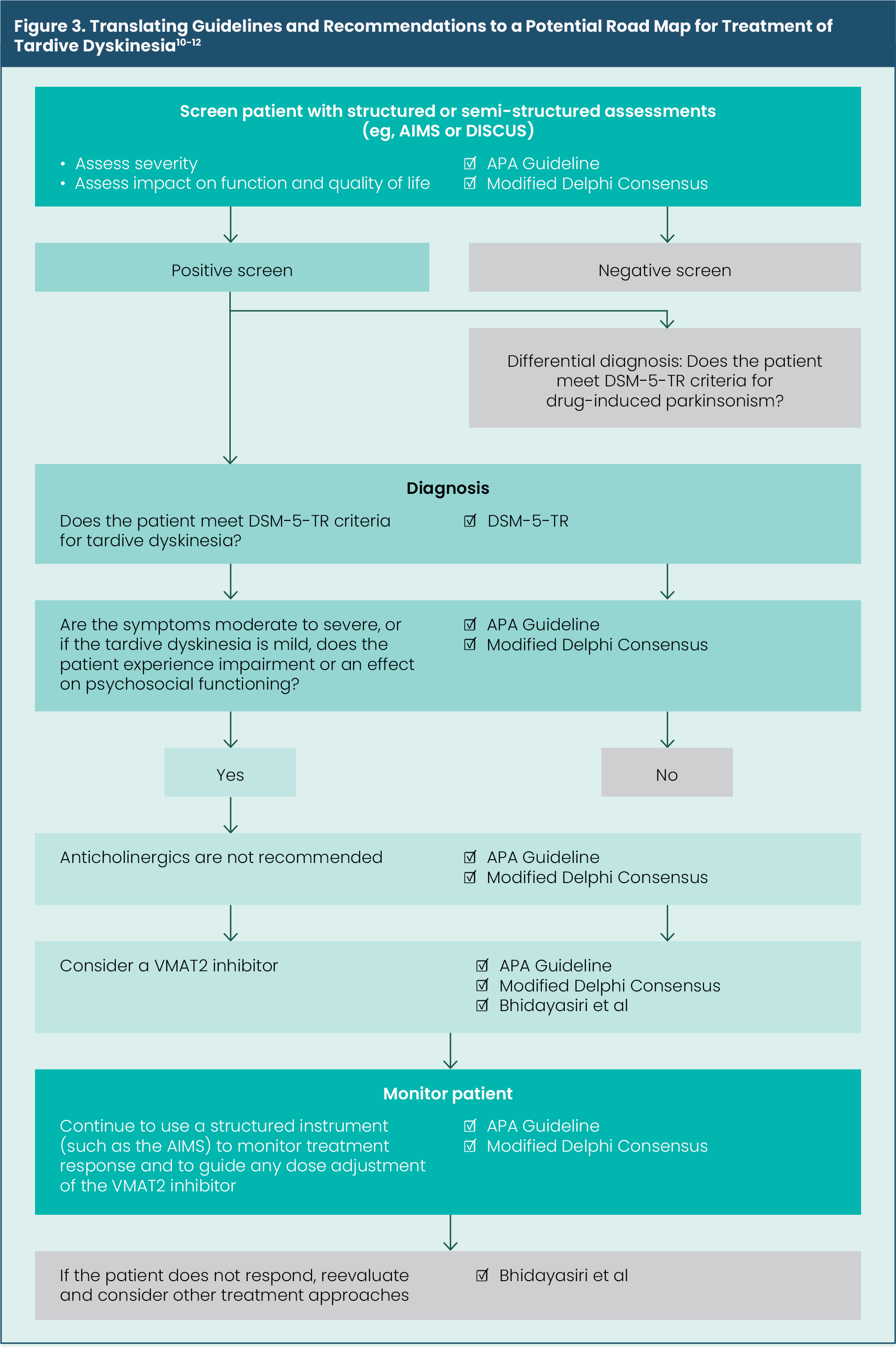
When should at-risk patients be screened for tardive dyskinesia? The APA guideline and the modified Delphi consensus both recommend informal screening at every clinical visit.11,12 Once a patient has screened positive for tardive dyskinesia, they should receive a full evaluation based on diagnostic criteria in the DSM-5-TR in order to receive an official diagnosis of tardive dyskinesia (Fig. 2).1
"I remember waking up one morning and my cheeks were moving in and out uncontrollably. It looked really weird! I remember that morning very clearly as it was very distressing for me… My tardive dyskinesia symptoms included grimacing, movements of my face and mouth, and trouble walking. Simple tasks like walking around the corner to my favorite eatery became difficult… I wasn’t prepared for how having tardive dyskinesia would make me feel or for its impact on my routine. Children would stare at me on the bus due to my weird faces. Because my symptoms are so visible to others, people often come to the conclusion that something is wrong with me or that I don’t pick up on things.”
– Jeff, a real patient with tardive dyskinesia
This patient was compensated by Neurocrine Biosciences, Inc., and has consented to Neurocrine’s use of their protected health information.
Figure 1. Who should be screened for tardive dyskinesia?
100%
of patients taking D2 blockers
Tardive dyskinesia is so much more than “just” a movement disorder. It exacts a heavy price from the afflicted individual’s life in terms of bio-psycho-social functioning. And despite functional impact being the rule and not the exception, we clinicians often miss out on the opportunity to go beyond the mere screening and diagnosis of the disorder—to evaluating its functional impact on the individual. After all, it is only after one takes a full measure of the functional impact of tardive dyskinesia that one can optimally treat a patient suffering from this condition.
– Rakesh Jain, MD, MPH Psychiatry
Figure 2. DSM-5-TR Diagnostic Criteria for Tardive Dyskinesia1
Signs and symptoms develop over a period of ≥4 weeks
Signs and symptoms develop during exposure to an antipsychotic or other dopamine blocking agent, or within 4 weeks of withdrawal from an oral agent (or within 8 weeks of withdrawal from a long-acting injectable agent)
There must be a history of use of the agent for ≥3 months or ≥1 month for people aged ≥60 years
The modified Delphi consensus calls for the consideration of even mild movements (ie, score of 2 on the AIMS) in one body region as possible tardive dyskinesia. Additionally, it is necessary to evaluate more than only orofacial movements—in other words, movements affecting other areas of the body need to be assessed.12 Functional impairment needs to be considered as well, and although the AIMS includes one question regarding incapacitation due to tardive dyskinesia (item 9), this can be assessed more optimally across several distinct dimensions: social, psychological/psychiatric, physical, and vocational/educational/recreational.22
Treatment of Tardive Dyskinesia
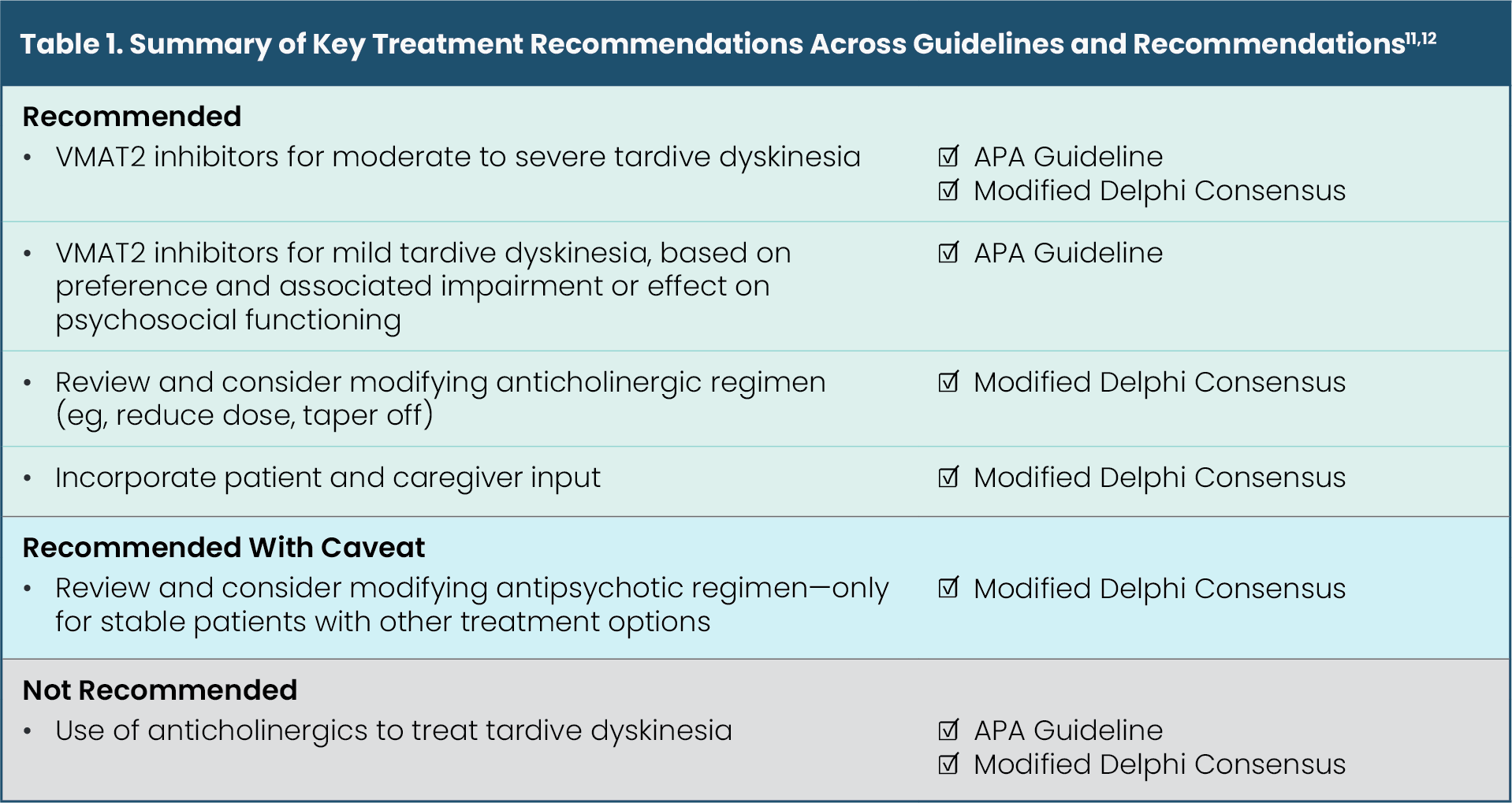
In 2017, vesicular monoamine transporter type 2 (VMAT2) inhibitors were approved by the US Food and Drug Administration (FDA) for the treatment of tardive dyskinesia, representing the first safe and effective treatment option approved for this condition.23,24 The recommendation to use these FDA-approved therapies for tardive dyskinesia is unanimous across the systematic review by Bhidayasiri et al,10 the APA treatment guidelines for schizophrenia,11 and the modified Delphi consensus (Table 1 and Fig. 3).12 Although all 3 sets of recommendations recommend VMAT2 inhibitors for patients with moderate to severe tardive dyskinesia, the APA guideline recommends VMAT2 inhibitors to be offered to patients with mild tardive dyskinesia as well, based on preference and associated impairment or effect on psychosocial functioning.11 This is an important point to keep in mind, considering the clearly documented effect of tardive dyskinesia on patients’ physical and mental function, quality of life, and ability to socialize with others.18 This is why the recommendation to assess impact on function and quality of life during screening and diagnosis is so important.
The APA guideline and the modified Delphi consensus clearly state that anticholinergics are not recommended for patients with tardive dyskinesia.11,12 The modified Delphi consensus recommends that clinicians review and consider modifying (ie, reduce or taper off dose) the anticholinergic regimen.12 The reason for this unanimous recommendation is that not all movement disorders are the same. Different mechanisms of disease distinguish tardive dyskinesia from other movement disorders and require distinct treatment approaches.11 In particular, drug-induced parkinsonism, which results from acute postsynaptic dopamine receptor blockade by antipsychotics, may lead to reduced dopamine signaling in the dorsal (motor) striatum. On the other hand, tardive dyskinesia is believed to develop due to prolonged dopamine receptor blockade by antipsychotics, resulting in compensatory increase in signaling at dopamine D2 receptors in the dorsal striatum.25-27 Thus, the use of anticholinergic agents not only will not alleviate the symptoms of tardive dyskinesia, but it may actually worsen them.11,28
The modified Delphi consensus also recommends that providers consider tapering the antipsychotic agent, but only in patients who can be safely withdrawn from antipsychotic therapy (ie, for whom alternative therapies are approved and available).12 However, there was unanimous agreement among the modified Delphi consensus panel that severity, stability, and risk of relapse of the underlying psychiatric disorder were important considerations.12 Furthermore, the APA guideline notes that the evidence for treating tardive dyskinesia by lowering antipsychotic dose is “minimal.”11
We finally have effective medications for the treatment of a once-feared side effect of medications. We should no longer ignore the elephant in the room. Instead, we should proactively recommend treatment with VMAT2 inhibitors to appropriate patients to aid in their overall recovery. We need not just treat a patient’s underlying psychiatric diagnosis; instead, we need to treat the whole patient.
– Rebecca Roma, MD Psychiatry
“I’m very happy my doctor listened to me when I told him about my symptoms and am glad I talked to him about treatment options.”
– Kathie, a real patient with tardive dyskinesia
This patient was compensated by Neurocrine Biosciences, Inc., and has consented to Neurocrine’s use of their protected health information.
Monitoring Tardive Dyskinesia
After tardive dyskinesia has been identified through screening, diagnosis has been made, and the patient has received treatment, the monitoring stage begins—and this phase is essential for achieving the best outcomes. The APA guideline recommends ongoing assessment of symptoms and impact on patient function and quality of life.11 The recommendation is for clinicians to use a structured instrument such as the AIMS or the DISCUS at regular intervals.4,11,12 An unstructured assessment can be used at every clinical visit as a routine.
Linh, a 64-year-old, came in complaining of abnormal movement in the face and truncal area. She had been on a first-generation antipsychotic for 15 years, which had helped with her bipolar disorder, but had little to no monitoring by her psychiatrist. She had not checked in with her psychiatrist for 3 years. The tardive dyskinesia she had developed had led to head thrashing while in bed, so much so she had created a bald spot on the back of her head. She was embarrassed and uncomfortable, refusing to see family other than her husband. We immediately started her on a VMAT2 inhibitor and referred her to a new psychiatrist, who discontinued her FGA and placed her on an SGA. Her symptoms of tardive dyskinesia have improved. Linh, her husband, and her family are so grateful and appreciative that the symptoms of tardive dyskinesia have greatly improved while her bipolar disorder continues to be controlled.
– Sherrie E. Gould, MSN, NP-C Neurology
“My doctor also works with me and answers any additional questions I might have. I used to think, ‘Oh, I’ll just stop taking my medication and it’ll go away, and I’ll be okay,’ but that didn’t happen. I stopped taking my medication but still had tardive dyskinesia symptoms and then I went into a mental health crisis and had to be hospitalized again. Not taking the medication is not the answer… I’ve had psychiatrists in the past who I didn’t have a good relationship with. I felt like I was in and out of the office—given my prescription and then was out of there. And we never really talked, and that wasn’t good for me. It was important for me to have a lot of communication with my doctor to get the treatment I needed.”
– Terry, a real patient with tardive dyskinesia
This patient was compensated by Neurocrine Biosciences, Inc., and has consented to Neurocrine’s use of their protected health information.
Conclusion
Despite early beliefs that tardive dyskinesia is a syndrome that only affects patients with chronic and serious mental illness or is only a concern with people taking FGAs, recent research has shown that it can and does affect younger adults as well as those taking SGAs (and other medications that block dopamine D2 receptors). Tardive dyskinesia is not a “cosmetic disorder,” and has been shown to impact function and quality of life and to increase social isolation. Moreover, with the increase in use of antipsychotic medication for multiple diagnoses, tardive dyskinesia treatment is as important as ever.
Recent treatment guidelines can help clinicians meet this urgent patient need by providing a road map to screening, diagnosis, treatment, and monitoring. The availability of specific, targeted VMAT2 inhibitor treatments for tardive dyskinesia offers options to patients, caregivers, and clinicians.
Disclosures
The faculty have been compensated by Neurocrine to serve as reviewers for this publication. Dr. Rakesh Jain is a consultant for AbbVie (Allergan), Acadia, Adamas, Alfasigma, Axsome, Biogen, Boehringer Ingelheim, Corium, Cingulate Therapeutics, Eisai, Evidera, Impel, Janssen, Eli Lilly, Lundbeck, Merck, Neos Therapeutics, Neurocrine, Osmotica, Otsuka, Pamlab, Pfizer, Sage Therapeutics, Shire, Sunovion, Supernus, Takeda, Teva and Transcend Therapeutics. He is on the speaker bureau for AbbVie (Allergan), Alkermes, Axsome, Corium, Eisai, Indivior, Intra-Cellular Therapies, Ironshore Pharmaceuticals, Janssen, Eli Lilly, Lundbeck, Merck, Neos Therapeutics, Neurocrine, Otsuka, Pamlab, Pfizer, Shire, Sunovion, Takeda, Teva, and Tris Pharmaceuticals. Dr. Jain receives research support from AbbVie (Allergan), Eli Lilly, Lundbeck, Otsuka, Pfizer, Shire, and Takeda. He serves on advisory boards for Adamas, Alkermes, Corium, Eisai, Janssen, Eli Lilly, Lundbeck, Merck, Neos Therapeutics, Neurocrine, Otsuka, Pamlab, Pfizer, Sage, Shire, Sunovion, Supernus, Takeda, Teva, and Usona. Tiffany Arnold is a consultant and is on the speaker bureau for Neurocrine. Dr. Leslie Citrome is a consultant for AbbVie (Allergan), Acadia, Adamas, Alkermes, Angelini, Astellas, Avanir, Axsome, BioXcel, Boehringer Ingelheim, Cadent Therapeutics, Cerevel, Clinilabs, COMPASS, Eisai, Enteris BioPharma, HLS Therapeutics, Idorsia, INmune Bio, Impel, Intra-Cellular Therapies, Janssen, Karuna, Lundbeck, Lyndra, Medavante-ProPhase, Marvin, Merck, Mitsubishi Tanabe Pharma, Neurocrine, Neurelis, Novartis, Noven, Otsuka, Ovid, Praxis, Recordati, Relmada, Reviva, Sage, Sunovion, Supernus, Teva, University of Arizona, and Vanda, and provides one-off ad hoc consulting for individuals/entities conducting marketing, commercial, or scientific scoping research. He is on the speaker bureau for AbbVie (Allergan), Acadia, Alkermes, Angelini, Axsome, BioXcel, Eisai, Idorsia, Intra-Cellular Therapies, Janssen, Lundbeck, Neurocrine, Noven, Otsuka, Recordati, Sage, Sunovion, Takeda, and Teva, and CME activities organized by medical education companies, such as Medscape, NACCME, NEI, Vindico, universities, and professional organizations/societies. Dr. Citrome owns stock in Bristol Myers Squibb, Eli Lilly, Johnson & Johnson, Merck, and Pfizer (purchased >10 years ago) and has stock options in Reviva. He receives royalties/publishing income from Taylor & Francis (Editor-in-Chief, Current Medical Research and Opinion, 2022 to present), Wiley (Editor-in-Chief, International Journal of Clinical Practice, through end of 2019), UpToDate (reviewer), Springer Healthcare (book), and Elsevier (topic editor, Psychiatry, Clinical Therapeutics). Sherrie E. Gould is a consultant for Abbott and Boston Scientific. She is on the speaker bureau for Acadia, Supernus, Abbott, Neurocrine, and Acorda and receives research support from Aspen Neurotherapeutics. Dr. Sanjay Gupta is a consultant for Neurocrine and is on the speaker bureau for AbbVie (Allergan), Alkermes, Intra-Cellular Therapies, Janssen, Neurocrine, and Otsuka. Dr. Adam F. Lowy is on the speaker bureau for Axsome, Alkermes, and Neurocrine. Dr. Leslie Lundt is an employee of Neurocrine. Dr. Maria C. Ospina is a consultant for AbbVie (Allergan), Supernus, Amneal, Acorda, Teva, and Neurocrine. She is on the speaker bureau for AbbVie (Allergan), Supernus, Amneal, Acorda, Teva, Adamas, Neurocrine, and Kyowa. Dr. Rebecca Roma is a consultant and is on the speaker bureau for Alkermes, Intra-Cellular Therapies, Janssen, Lundbeck, Neurocrine, Otsuka, and Teva.
Plain Language Summary
Tardive dyskinesia is a movement disorder that can affect many body parts.2
Anyone who has taken or is taking certain medications that block dopamine could become affected by tardive dyskinesia.4
Tardive dyskinesia can be very disruptive to people’s lives and should be treated, even if symptoms are mild, based on patient preference or degree of negative impact.11
What do expert guidelines say about diagnosis and treatment of tardive dyskinesia?
Several guidelines make recommendations on how tardive dyskinesia should be diagnosed and treated. Overall, these guidelines recommend:
Everyone taking dopamine receptor blocking drugs should be screened for tardive dyskinesia11,12
Tardive dyskinesia should be treated with a medication called a VMAT2 inhibitor if it is moderate to severe or if it is mild but makes it difficult for patients to function, or based on the patient’s preference10-12
Medications called anticholinergics should not be used to treat tardive dyskinesia because they may worsen tardive dyskinesia11,12
Patients should be monitored for tardive dyskinesia every 6 months if they are at high risk and every 12 months if they are not11
If a patient’s tardive dyskinesia does not respond to initial treatment, clinicians can try other options12
Take Home Message
More people are taking antipsychotic medications for different reasons, so recognizing and treating tardive dyskinesia is very important. Recent treatment guidelines can help clinicians decide whom to screen and monitor and whom to treat. Treatments called VMAT2 inhibitors offer hope to patients, caregivers, and clinicians.
For Medical Use.
Up Next
Mechanism of Disease: Tardive Dyskinesia
Discover the proposed mechanism of disease underlying tardive dyskinesia in this educational animation.
Up Next
The Abnormal Movement Questionnaire
Utilize this questionnaire to support the assessment of abnormal involuntary movements across multiple regions of the body, as well as their physical, social, and emotional impact on your patients.
Empty space, drag to resize
Empty space, drag to resize
Empty space, drag to resize
References
1. American Psychiatric Association. Diagnostic and Statistical Manual of Mental Disorders. 5th ed., text rev. American Psychiatric Association; 2022. 2. Hauser RA, Meyer JM, Factor SA, et al. Differentiating tardive dyskinesia: a video-based review of antipsychotic-induced movement disorders in clinical practice. CNS Spectr. 2022;27(2):208-217. 3. Tarsy D. Tardive dyskinesia. Curr Treat Options Neurol. 2000;2(3):205-214. 4. Caroff SN. Overcoming barriers to effective management of tardive dyskinesia. Neuropsychiatr Dis Treat. 2019;15:785-794. 5. Fahn S, Jankovic J, Hallet M. The tardive syndromes. In: Fahn S, Jankovic J, Hallet M, eds. Principles and Practice of Movement Disorders. 2nd ed. Saunders; 2011:415-446. 6. Yohanna D, Cifu AS. Antipsychotics to treat agitation or psychosis in patients with dementia. JAMA. 2017;318(11):1057-1058. 7. Cloud LJ, Zutshi D, Factor SA. Tardive dyskinesia: therapeutic options for an increasingly common disorder. Neurotherapeutics. 2014;11:166-176. 8. Robert L. Tardive dyskinesia facts and figures. Psychiatric Times. May 30, 2019. Accessed December 1, 2022. https://www.psychiatrictimes.com/view/tardive-dyskinesia-facts-and-figures 9. Carbon M, Hsieh CH, Kane JM, et al. Tardive dyskinesia prevalence in the period of second-generation antipsychotic use: a meta-analysis. J Clin Psychiatry. 2017;78(3):e264-e278. 10. Bhidayasiri R, Jitkritsadakul O, Friedman JH, Fahn S. Updating the recommendations for treatment of tardive syndromes: a systematic review of new evidence and practical treatment algorithm. J Neurol Sci. 2018;389:67-75. 11. American Psychiatric Association. The American Psychiatric Association Practice Guideline for the Treatment of Patients With Schizophrenia. American Psychiatric Association; 2020. 12. Caroff SN, Citrome L, Meyer J, et al. A modified Delphi consensus study of the screening, diagnosis, and treatment of tardive dyskinesia. J Clin Psychiatry. 2020;81(2):19cs12983. 13. Vrtunski PB, Alphs LD, Meltzer HY. Isometric force control in schizophrenic patients with tardive dyskinesia. Psychiatry Res. 1991;37(1):57-72. 14. Lumetti S, Ghiacci G, Macaluso GM, et al. Tardive dyskinesia, oral parafunction, and implant-supported rehabilitation. Case Rep Dent. 2016;2016:7167452. 15. Girard P, Monette C, Normandeau L, et al. Contribution of orodental status to the intensity of orofacial tardive dyskinesia: an interdisciplinary and video-based assessment. J Psychiatr Res. 2012;46(5):684-687. 16. Gregory RP, Smith PT, Rudge P. Tardive dyskinesia presenting as severe dysphagia. J Neurol Neurosurg Psychiatry. 1992;55(12):1203-1204. 17. Bhat PS, Pardal PK, Diwakar M. Dysphagia due to tardive dyskinesia. Ind Psychiatry J. 2010;19(2):134-135. 18. McEvoy J, Gandhi SK, Rizio AA, et al. Effect of tardive dyskinesia on quality of life in patients with bipolar disorder, major depressive disorder, and schizophrenia. Qual Life Res. 2019;28(12):3303-3312. 19. Data on file. Neurocrine Biosciences, Inc. 20. Rush JA Jr, First MB, Blacker D. Abnormal Involuntary Movement Scale (AIMS) - overview. In: Rush JA Jr, First MB, Blacker D, eds. Handbook of Psychiatric Measures. American Psychiatric Association; 2000: 166-168. 21. Kalachnick JE, Sprague RL. The Dyskinesia Identification System Condensed User Scale (DISCUS): reliability, validity, and total score cut-off for mentally ill and mentally retarded populations. J Clin Psychiatry. 1993;49(2):177-189. 22. Jackson R, Brams MN, Carlozzi NE, et al. Impact-Tardive Dyskinesia (Impact-TD) Scale: a clinical tool to assess the impact of tardive dyskinesia. J Clin Psychiatry. 2022;84(1):22cs14563. 23. INGREZZA. Prescribing information. Neurocrine Biosciences, Inc.; 2021. Accessed February 1, 2023. https://www.neurocrine.com/assets/2023/01/INGREZZA-Full-Prescribing-Information.pdf#page=18 24. AUSTEDO. Prescribing information. Teva Neuroscience, Inc.; 2022. Accessed February 1, 2023. https://www.austedo.com/globalassets/austedo/prescribing-information.pdf 25. Shin H-W, Chung SJ. Drug-induced parkinsonism. J Clin Neurol. 2012;8(1):15-21. 26. Stahl SM. Neuronal traffic signals in tardive dyskinesia: not enough “stop” in the motor striatum. CNS Spectr. 2017;22(6):427-434. 27. Stahl SM. Antipsychotic agents. In: Stahl SM, ed. Stahl’s Essential Pharmacology. 4th ed. Cambridge University Press; 2013:145-252. 28. Benztropine mesylate. Package insert. Akorn; 2017.
Empty space, drag to resize
MED-MSL-TD-US-0312
Your Resources on Tardive Dyskinesia and Other DIMDs
These
free educational resources are
sponsored and developed by
Neurocrine Biosciences, Inc.
Discover TD®
In this interactive application, users can differentially diagnose and develop appropriate
management plans for hypothetical, virtual patients with various movement disorders.
DIMD Course
Enroll in this free, virtual self-paced learning platform delving into various clinical aspects of the most common DRBA-induced movement disorders and earn a recognized certificate of completion.
Media Platforms
TD Dialogues® Podcast
Hear from experts in insightful conversations as they discuss the challenges of recognizing TD and share real-world strategies to effectively support patients
in managing symptoms.
This channel features educational videos designed
to further understanding of TD, including content on the proposed mechanism of disease in TD and differentiating TD from drug-induced parkinsonism.
Explore the DIMD Ecosystem Library
Want to explore our collection of DIMD educational resources on your own? Use the link below to view the full content library.
This educational
content was sponsored and developed
by Neurocrine Biosciences, Inc. This
non-CME program is intended to
provide general information about
drug-induced movement disorders and
not medical advice for any particular
patient.