
Inappropriate Anticholinergic Use In Tardive Dyskinesia (TD)
Key Differences in Pharmacologic Effect of Common Treatment Strategies for TD1
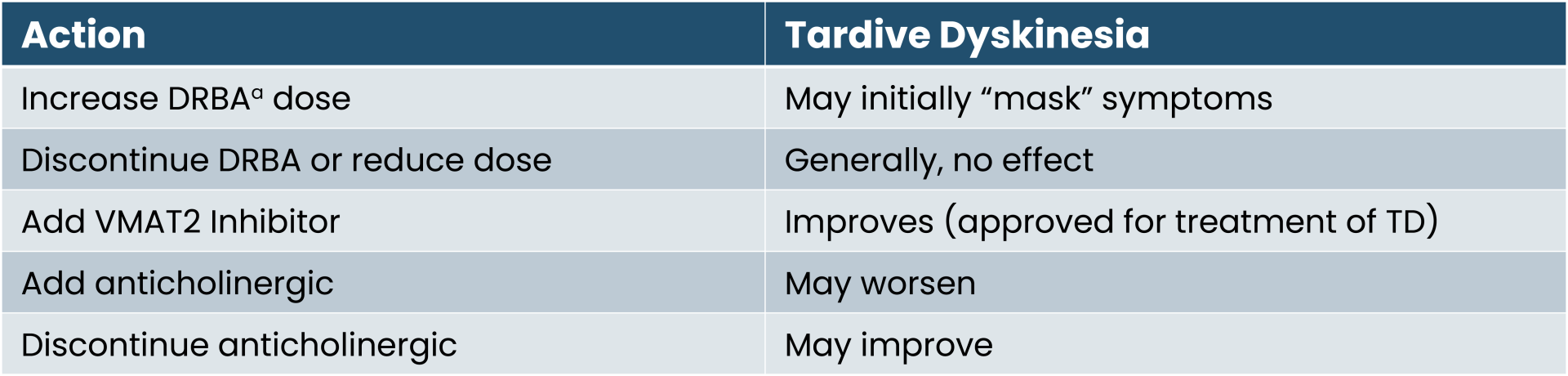
Anticholinergics block acetylcholine receptors in the central and autonomic nervous system, and are used to treat a variety of conditions
Benztropine Prescribing Information2

“Benztropine is not recommended for use in patients with TD”
Benztropine in Guidelines
American Academy of Neurology (AAN)
American Psychiatric Association (APA)
American Academy of Neurology (AAN)
- No controlled trials examining the efficacy of benztropine, biperiden, chlorprothixene, and trihexyphenidyl in treating TD
- Insufficient data to determine the effectiveness of anticholinergics for the treatment of TD (Level U)
American Psychiatric Association (APA)
The symptoms of tardive dyskinesia tend to be worsened by stimulants, antipsychotic medication withdrawal, and anticholinergic medications (such as benztropine) and may be transiently worsened by emotional arousal, stress, and distraction during voluntary movements in unaffected parts of the body
The need for anticholinergic medication(s) should be reconsidered regularly to reduce anticholinergic burden5
American Geriatric Society’s Beers Criteria6
What are the AGS Beers Criteria?
An explicit list of potentially inappropriate medications that are best avoided by adults aged ≥ 65 years old
What is the Purpose of the AGS Beers Criteria?
Educate clinicians and patients
Reduce adverse drug events
Tardive Dyskinesia
VMAT 2 Inhibitors Recommended by APA Clinical Guidelines9
VMAT2 inhibitors can also be considered for patients with mild TD
There is insufficient evidence to support a guideline statement on the use of the following treatments in individuals with TD:
Anticholinergics (e.g., benztropine)
Benzodiazepines (e.g., clonazepam)
Change in antipsychotic therapy to a lower-potency medication
Ginkgo biloba
Cessation or reduction of antipsychotic medication
Amantadine
Vitamin E
For Medical Information Only.

a) Dopamine Receptor Blocking Agent
2. Benztropine mesylate [package insert]. Warren, NJ: Cipla USA, Inc.; 2020.
3. Bhidayasiri R, et al. Neurology. 2013;81(5):463-469.
4. APA: DSM-5-TR. Washington, DC. 2022.
6. 2023 American Geriatrics Society Beers Criteria® Update Expert Panel. J Am Geriatr Soc. 2023;2023(71):2052–81.
7. American Psychiatric Association: Diagnostic and Stat Diagnostic and Statistical Manual of Mental Disorders. Fifth Edition – Text Revision. American Psychiatric
8. Klawans H, et al. Acta Neurol Scand. 1970;46(4):409-441.
9. American Psychiatric Association. Clinical Practice Guidelines for Treatment of Patients with Schizophrenia. Accessed on November 8, 2020.
MED-MSL-VBZ-US-0015
Your Resources on Tardive Dyskinesia and Other DIMDs

Media Platforms



Copyright © 2026